

Industrial Plastic 3-Way Valves: Flow Port Configurations, Material Selection & Engineering Specifications
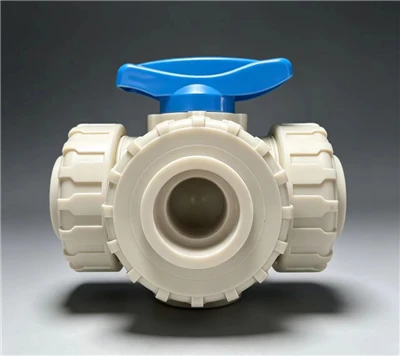
Plastic 3-Way Valves handle fluid routing, diversion, and proportional mixing across chemical processing, water treatment, electroplating, and industrial piping networks. Compared to metallic valves, thermoplastic 3-way valves prevent galvanic corrosion, resist aggressive chemical exposure, and reduce total structural payload on unsupported pipe runs.
A single 3-way valve replaces two conventional 2-way inline valves and a reducing tee fitting. This setup eliminates two pipe joints, lowers total installation labor costs, reduces potential leakage points within liquid lines, and minimizes pressure drop across the manifold.


Product Range
PVC 3-Way Ball Valve
Operating Temperature: 0°C to 60°C (32°F to 140°F)
Working Pressure: PN10 / PN16 (150 PSI at 73°F)
Key Media: Potable water, municipal wastewater, mild acid/alkali solutions, saline solutions
Primary Limitation: Vulnerable to thermal degradation above 60°C; non-resistant to aromatic hydrocarbons and polar solvents (ketones, esters).
CPVC 3-Way Ball Valve
Operating Temperature: 0°C to 95°C (32°F to 203°F)
Working Pressure: PN10 / PN16 (150 PSI at 73°F, derated at elevated temperatures)
Key Media: Hot corrosive fluids, chlorinated acids, sodium hypochlorite, plating solutions
Primary Limitation: Lower impact resistance at sub-zero temperatures; susceptible to environmental stress cracking under contact with certain synthetic oils.
PPH 3-Way Ball Valve
Operating Temperature: -10°C to 95°C (14°F to 203°F)
Working Pressure: PN10 (150 PSI at 20°C)
Key Media: Pickling acids, alkaline solutions, industrial wash water, organic solvents
Primary Limitation: Permeable to strong oxidizing agents (such as concentrated nitric acid, sulfuric acid above 90%).
PVDF 3-Way Ball Valve
Operating Temperature: -40°C to 140°C (-40°F to 284°F)
Working Pressure: PN16 (232 PSI at 20°C)
Key Media: High-purity deionized water, ultra-pure chemicals, concentrated nitric acid, hydrofluoric acid, halogen compounds
Primary Limitation: Higher raw material cost; heavier per unit volume compared to PVC and PPH.
Plastic 3-Way Diverter Valve
Internal Ball Structure: L-Port / T-Port directional flow diverter
Functionality: Redirects media flow from one common inlet to one of two alternative outlet lines.
Sealing Mechanism: Fully encapsulated PTFE seats prevent fluid trapping inside the valve body cavity during flow transfer.
Plastic 3-Way Mixing Valve
Internal Ball Structure: T-Port fluid blending configuration
Functionality: Combines flow streams from two separate inlet ports into a single common outlet port at specified ratios.
Sealing Mechanism: Dual O-ring stem seals maintain external leak integrity during continuous throttling or modulating operations.
Key Product Characteristics
L-Port Flow Configuration (Diverting / 90-Degree Turn)
Flow Mechanism: Diverts media from Port 1 to Port 2 in Position 1. Rotated 90 degrees to Position 2, flow is redirected from Port 3 to Port 2.
Function: Serves as a 2-way directional diverter between two separate lines.
T-Port Flow Configuration (Mixing & Multi-Directional)
Flow Mechanism: Combines flow from Port 1 and Port 3 into Port 2 for fluid blending. Can also be positioned for straight-through flow (Port 1 to Port 3) or 90-degree diverting.
Function: Provides multi-directional fluid handling and proportional mixing.
True Union Body Design: Double union nuts allow inline removal of the central body for maintenance or seat replacement without dismantling line pipe segments.
Full-Bore Hydrodynamic Path: Internal flow passages match nominal pipe inner diameters (ID), minimizing head loss, reducing turbulence, and preventing media cavitation.
Blowout-Proof Stem System: Bottom-loaded stems incorporate an integral collar that prevents stem ejection under internal line pressure spikes.
Dual Stem O-Ring Seals: Standard FKM or EPDM double seals provide secondary containment against stem leakage during high-cycle operation.
Actuation-Ready Mounting Pad: ISO 5211 compliant top-flange drilling patterns enable direct mounting of pneumatic or electric actuators without external brackets.
Material & Media Compatibility
|
Material |
Max Temp |
Recommended Media |
Incompatible Media |
Tensile Strength |
Shore Hardness |
|
PVC |
60°C (140°F) |
Dilute acids, bases, salts, treated water |
Acetone, benzene, ethers, aromatic hydrocarbons |
50-55 MPa |
80-85 (Shore D) |
|
CPVC |
95°C (203°F) |
Mineral acids, hot alkaline solutions, bleach |
Ketones, esters, liquid chlorine |
55-60 MPa |
82-87 (Shore D) |
|
PPH |
95°C (203°F) |
Organic acids, caustic soda, pickling baths |
Concentrated nitric/sulfuric acid, halogens |
30-35 MPa |
70-75 (Shore D) |
|
PVDF |
140°C (284°F) |
Hot concentrated acids, ultra-pure chemicals, halogens |
Fuming sulfuric acid, strong polar amines |
50-55 MPa |
75-80 (Shore D) |
|
PTFE (Seats) |
200°C (392°F) |
Universal chemical resistance across pH 1-14 |
Molten alkali metals, elemental fluorine gas |
20-30 MPa |
55-60 (Shore D) |
|
FKM (Seals) |
200°C (392°F) |
Mineral acids, petroleum products, chlorine water |
Low-molecular-weight organic acids, hot water/steam |
12-15 MPa |
70-75 (Shore A) |
|
EPDM (Seals) |
120°C (248°F) |
Hot water, dilute acids/alkalis, ozone |
Oils, greases, aromatic hydrocarbons |
10-13 MPa |
70-75 (Shore A) |
Connection & Configuration Options
Plastic 3-Way Valve Configurator Breakdown
End Connections: Socket (ANSI, DIN, JIS), Threaded (NPT, BSPT), or Flanged (ANSI Class 150, DIN PN10/PN16).
Flow Port Patterns: L-Port (90-degree diverting) or T-Port (straight-through, mixing, or diverting).
Actuation Modes: Manual Lever (with locking option), Pneumatic Actuator (Double Acting / Spring Return), or Electric Actuator (24V / 220V).
End Connection Types
Socket Ends: Solvent cement sockets for PVC/CPVC (ANSI B1.20.1 / DIN / JIS standards); socket-fusion socket ends for PPH and PVDF.
Threaded Ends: Female NPT (ANSI/ASME B1.20.1) and BSPT (ISO 7-1) precision-tapered threads reinforced with outer wall thickness margins.
Flanged Ends: Integral or stub-end flanges conforming to ANSI Class 150, DIN PN10/16, or JIS 10K bolt hole patterns.

Flow Port Configurations
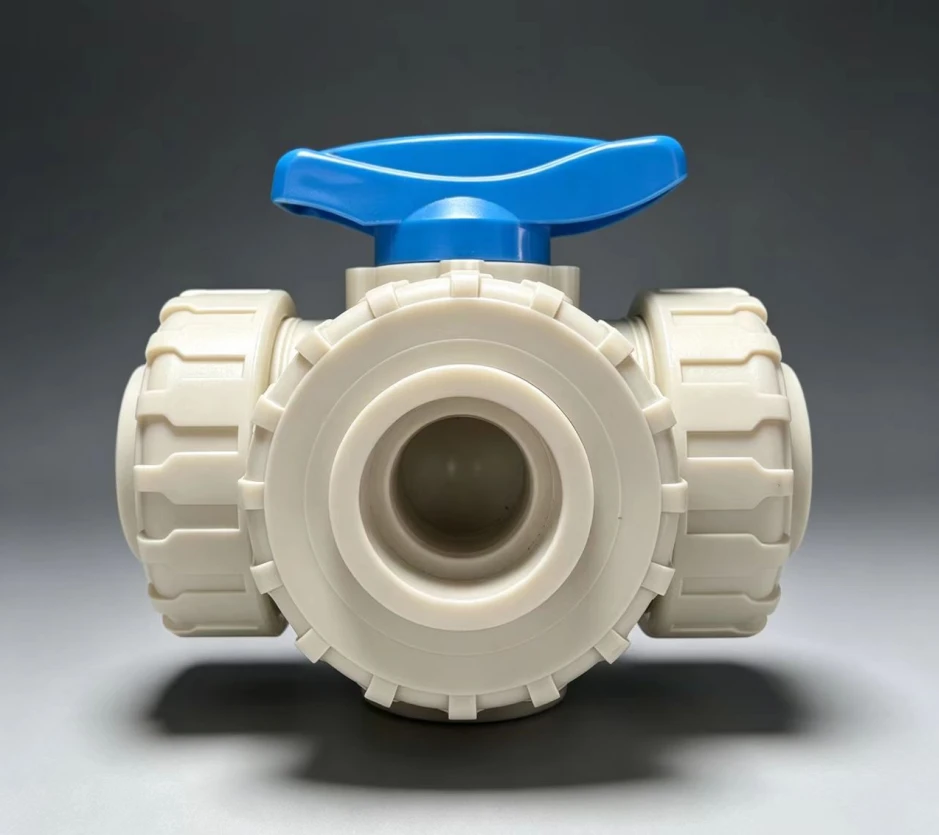
L-Port Pattern (90-Degree Turn): Diverts flow from a common bottom or center port to either the left or right port. Cannot connect all three ports simultaneously.
T-Port Pattern (360 / 180 / 90 Degree Turn): Allows straight-through flow, 90-degree diverting, or simultaneous 3-port mixing depending on handle position and ball alignment.
Actuation Interfaces
Manual Operation: Ergonomic lever handle with built-in position indicator and padlocking facility for lock-out/tag-out (LOTO) procedures.
Pneumatic Actuation: Double-acting (DA) or spring-return (SR) rack-and-pinion actuators with NAMUR solenoid valve mounting pads.
Electric Actuation: On/off or modulating control actuators (4-20mA / 0-10V input) rated to IP67/NEMA 4X enclosures.
Key Specifications
|
Parameter |
Metric Range |
Imperial Range |
Test Method / Standard |
|
Nominal Diameters |
DN15 - DN100 |
1/2" - 4" |
ISO 6708 / ASME B16.34 |
|
Pressure Ratings |
PN10 / PN16 |
150 PSI @ 73°F |
ISO 9393 / ASTM F1970 |
|
Shell Hydrostatic Test |
1.5 x PN (1.5 - 2.4 MPa) |
225 - 348 PSI |
EN 12266-1 / API 598 |
|
Seat Leakage Test |
Rate A (Zero bubble leakage) |
Rate A |
ISO 5208 / EN 12266-1 |
|
Operating Torque |
5 N·m - 45 N·m |
44 in-lb - 398 in-lb |
Internal Factory Standard |
|
Temperature Range |
-40°C to 140°C |
-40°F to 284°F |
Material Dependent |
|
Mounting Flange |
ISO 5211 (F03 to F10) |
ISO 5211 (F03 to F10) |
ISO 5211 |
How to Select the Right Plastic Ball Valve
Calculate Line Operating Pressure and Temperature
Determine maximum working pressure and fluid temperature. Apply pressure-temperature derating factors (for example, PVC pressure rating drops by 50% at 45°C / 113°F).
Verify Chemical Compatibility
Cross-reference chemical composition, concentration percentage, and operating temperature against body resin (PVC, CPVC, PPH, PVDF) and elastomer seal charts (EPDM vs. FKM).
Determine Flow Function (L-Port vs. T-Port)
Use L-Port if the system requires strict 2-way switching from a common supply line to two alternative downstream destinations.
Use T-Port if the process requires blending two media streams or requires straight-through flow with an auxiliary branch option.
Select End Connection Standard:
Match system pipe schedules and joining methods (NPT threads for North American installations; metric socket/fusion for DIN/ISO systems; ANSI flanges for skid equipment).
Size the Valve Using Cv Flow Coefficients:
Ensure selected nominal size delivers required flow capacity without exceeding maximum allowable line velocity (Velocity < 2.5 m/s for liquid media).
Industrial Wastewater Treatment: Routing raw effluent, acid neutralization dosing lines, sludge diversion circuits.
Chemical Processing Facilities: Distribution of bulk acids (hydrochloric, hydrofluoric, sulfuric), bases (sodium hydroxide), and industrial solvents.
Semiconductor & Electronics Manufacturing: Ultra-pure water (UPW) distribution loops and wet-bench chemical delivery platforms using PVDF bodies.
Electroplating & Surface Finishing: Continuous transfer and filtration loop isolation for hot pickling, anodizing, and metal plating baths.
Commercial Aquatics & Aquaculture: Seawater recirculation, ozone injection loops, and filtration backwash diversion manifolds.

Quality & Inspection
Manufacturing & Quality Control Sequence
Raw Resin Testing
Melt Flow Index (MFI) and moisture content analysis to verify resin purity.
Injection Process Control
Closed-loop cavity pressure monitoring during molding.
Dimensional Audit
CMM inspection, plug gaging, and ISO 5211 alignment checks.
100% Hydrostatic & Pneumatic Test
Shell tested at 1.5x PN; seat air leakage tested at 1.1x PN.
Final Inspection & Shipping
Custom packaging, batch certificates (EN 10204), and full traceability tracking.
Raw Resin Verification
Incoming raw polymer granules undergo Melt Flow Index (MFI) and moisture content analysis to verify resin purity before injection molding.
Dimensional Consistency Controls
Molded bodies, stems, and union ends are verified via Coordinate Measuring Machines (CMM) and calibrated thread gauges.
100% Hydrostatic and Pneumatic Testing
Every manufactured valve undergoes a 1.5x PN shell hydrostatic pressure test and a 1.1x PN low-pressure pneumatic seat leak test according to EN 12266-1 standards prior to packing.
Destructive Burst Testing
Sample lots undergo destructive hydrostatic pressure testing to verify minimum 4x safety factor margins over rated PN pressure.
OEM / ODM & Customization
Custom Stem Lengths & Extensions
Stem extensions engineered for insulated piping systems or submerged tank mounting.
01
Private Labeling & Laser Marking
Permanent laser-etched logos, part numbers, QR codes, and custom pressure rating tags directly on valve bodies or handles.
02
Specialized Elastomer Compound Matching
Alternative elastomer seat/seal combinations (FFKM, AFLAS) for aggressive chemical combinations.
03
Custom Color Formulations
Custom body color matching (RAL codes) for specific system line identification or OEM brand alignment.
04
Skid-Ready Actuator Assembly
Factory pre-assembly, wiring, and limit-switch calibration of electric/pneumatic actuators onto 3-way valves before shipment.
05
FAQ

Request a Quote
Submit your specifications to receive an engineering quote, drawings, and compatibility confirmation within 24 hours.
Quick Inquiry Form
Contact Info: Company Name | Contact Person | Email | Phone/WhatsApp
Valve Type: L-Port / T-Port
Body Material: PVC / CPVC / PPH / PVDF
Valve Size: DN15 (1/2") to DN100 (4")
Seals & Connections: EPDM / FKM | Socket / Threaded (NPT/BSPT) / Flanged (ANSI/DIN)
Operation: Manual / Pneumatic / Electric
Operating Conditions: Media Name & Conc. (%) | Temp (°C/°F) | Pressure (Bar/PSI) | Quantity (Pcs)
We're well-known as one of the leading plastic 3-way valves manufacturers in China. If you're going to buy high quality plastic 3-way valves in stock, welcome to get quotation and free sample from our factory. Also, customized service is available.