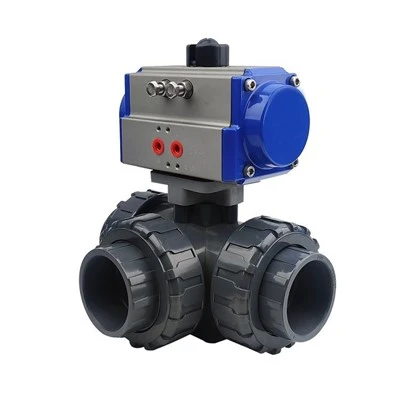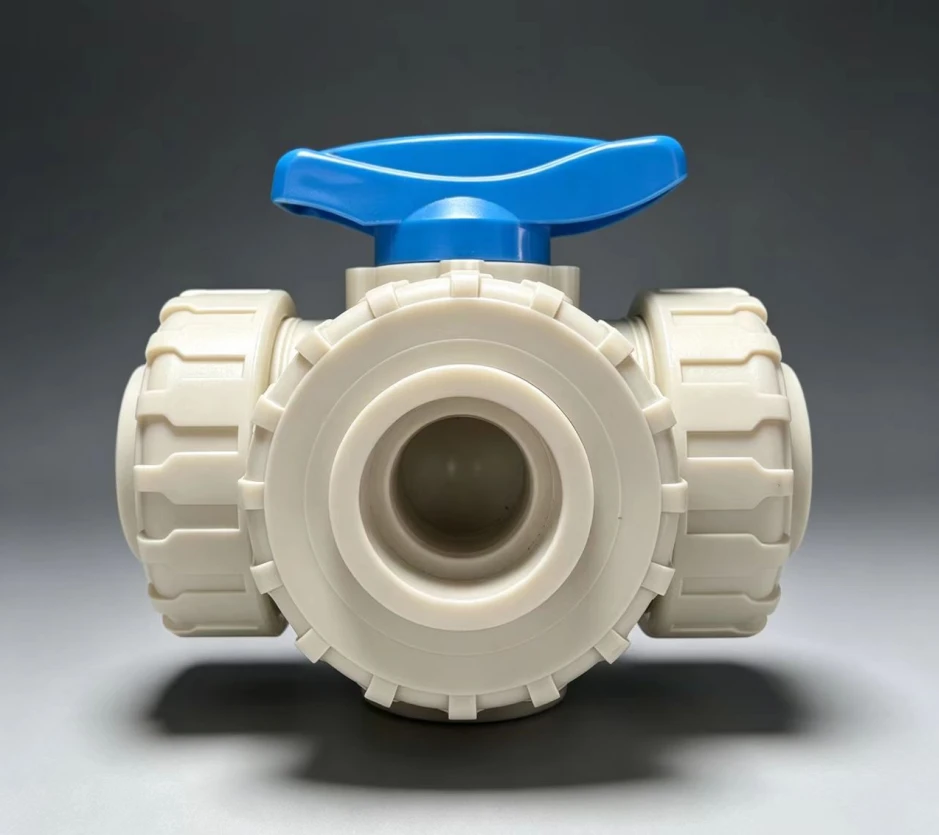
Plastic 3-Way Mixing Valve
This thermoplastic 3-way mixing valve blends or diverting fluid streams in low-to-medium pressure piping networks. Built with a T-port or L-port ball configuration, it provides precise flow control for water treatment, HVAC hydronics, chemical dosing, and automated irrigation systems.
Description
Product Overview
This thermoplastic 3-way mixing valve blends or diverting fluid streams in low-to-medium pressure piping networks. Built with a T-port or L-port ball configuration, it provides precise flow control for water treatment, HVAC hydronics, chemical dosing, and automated irrigation systems. The corrosion-resistant plastic body prevents galvanic degradation and scale accumulation, replacing metal alloys in corrosive fluid lines.
Key Product Characteristics
Corrosion Immunity: Non-metallic flow path eliminates oxidation, pitting, and chemical leaching when handling aggressive media or saline solutions.
Low Operating Torque: Precision-machined PTFE seats and smooth ball surface lower frictional resistance, enabling direct actuation with smaller, lower-power actuators.
Flow Direction Flexibility:
- T-Port: Enables 3-way mixing, 3-way diverting, or straight-through flow depending on handle/actuator rotation.
- L-Port: Provides 90-degree flow switching between two alternative outlets from a single inlet.
Dual-Stem Seal Protection: Double O-ring stem packing isolates the upper drive mechanism from system pressure spikes and line media.
Key Specifications
|
Parameter |
Metric Range / Value |
Imperial Range / Value |
|
Nominal Sizes (DN) |
DN15 to DN50 |
1/2 inch to 2 inch |
|
Pressure Rating (PN) |
PN10 to PN16 (at 20°C) |
150 PSI to 230 PSI (at 68°F) |
|
Working Temperature |
UPVC: 0°C to 60°C CPVC: 0°C to 95°C PPL/PPR: -20°C to 90°C |
UPVC: 32°F to 140°F CPVC: 32°F to 203°F PPL/PPR: -4°F to 194°F |
|
Flow Pattern |
T-Port / L-Port (90° / 180° positioning) |
T-Port / L-Port (90° / 180° positioning) |
|
Actuation Mounting |
ISO 5211 Direct Mounting Pad (F03/F05/F07) |
ISO 5211 Direct Mounting Pad (F03/F05/F07) |
|
Leakage Class |
ANSI/FCI 70-2 Class VI (Bubble-tight) |
ANSI/FCI 70-2 Class VI (Bubble-tight) |
Materials & Media Compatibility
Body & Ball Materials
UPVC (Unplasticized PVC): Cold water supply, municipal water treatment, light chemical transfer, HVAC secondary loops.
CPVC (Chlorinated PVC): Hot water circulation, commercial plumbing, industrial acid/alkali dosing up to 95°C.
PPL / PP-H (Polypropylene): Organic solvents, high-temperature aggressive chemicals, industrial effluent lines.
Seals & O-Rings
PTFE (Teflon) Ball Seats: High chemical inertness, non-stick coefficient of friction, wear resistance across thermal cycles.
EPDM O-Rings: Compatible with water, steam condensate, dilute acids, alkalis, and glycol mixtures.
FKM (Viton) O-Rings: Highly resistant to mineral oils, strong acids, hydrocarbons, and aromatic solvents.
Connection & Configuration Options
End Connections
Socket / Solvent Weld: ANSI / DIN / JIS standards for permanent leak-free jointing.
BSP / NPT Threaded: Female threaded end connectors for direct installation into existing threaded piping.
True Union (Double / Triple Union): Allows body removal from the pipeline without dismantling connected pipe ends.
Flanged: ANSI 150lb / DIN PN10 pattern for direct bolt-up in industrial processing skids.
Control Interfaces
Manual lever with lockable position indicator.
Bare stem with ISO 5211 flange for field automation.
Factory-assembled 24V/110V/220V AC/DC electric actuator or double-acting/spring-return pneumatic actuator.
Application-Specific Design Considerations
Pressure De-rating: Thermoplastic pressure limits decrease as operating temperatures increase. Refer to pressure-temperature curves when operating above 40°C.
Water Hammer Prevention: Motorized actuators feature configurable cycle times (5s to 30s) to prevent hydraulic shock in quick-closing liquid lines.
Cavitation & Flow Velocity: Maintain fluid velocity below 3 m/s to reduce turbulence and localized pressure drops across internal port edges.
Applications
HVAC & Hydronic Heating
Mixing supply and return water to control floor heating loop temperatures.
Water & Wastewater Treatment
Diverting reverse osmosis (RO) permeate or dosing sodium hypochlorite and coagulants.
Agricultural & Smart Irrigation
Automated fertilizer injection (fertigation) and zone switching in automated farm networks.
Aquaculture & Marine Recirculation
Managing seawater intake without metallic contamination or corrosion.
Quality & Inspection
Hydrostatic Pressure Testing: 100% of manufactured bodies undergo shell testing at 1.5x PN rating and seat testing at 1.1x PN rating.
Dimensional Consistency: CNC-machined ball spheres and body cavities achieve tolerances within plus/minus 0.02 mm to prevent seal deformation.
Traceability: Serial number laser-marking on each valve housing matches material batch certificates (EN 10204 3.1) and O-ring batch tracking.
OEM / ODM & Customization
Custom Porting & Flow Patterns: Customized ball drilling for specific flow percentages or throttling characteristics.
Private Labeling & Packaging: Customized handle colors, laser-etched logos, serial numbering, and barcode packaging.
Actuator Integration: Pre-wired custom voltage actuators, feedback potentiometers, 4-20mA positioners, and Modbus/RS485 communication protocols.
FAQ
Q: What is the main functional difference between a T-port and L-port 3-way valve?
A: A T-port valve can connect all three ports together or switch between two pathways, making it suited for mixing or diverting. An L-port valve connects the center port to either the left or right port exclusively (90-degree turn) for basic 2-way switching.
Q: Can this plastic mixing valve handle concentrated sulfuric or hydrochloric acid?
A: Yes. CPVC or PPL bodies paired with PTFE seats and FKM (Viton) O-rings resist aggressive acids. Always confirm chemical concentration and operating temperature prior to material selection.
Q: Is the valve operable directly via electric or pneumatic actuators without extra brackets?
A: Yes. The valve features an integrated ISO 5211 mounting pad and standard square stem drive, allowing direct actuator attachment without custom mounting kits.
Q: How does operating temperature affect the valve's pressure rating?
A: Nominal pressure ratings (e.g., PN16) apply at 20°C. As operating temperatures increase toward material limits (60°C for UPVC, 95°C for CPVC), allowable working pressure decreases proportionally per standard de-rating charts.
Q: Can individual seals and seats be replaced during routine maintenance?
A: True Union configurations allow quick inline disassembly. The valve body can be unthreaded from the union ends to replace PTFE seats and stem O-rings without cutting the pipe.
Q: What certifications and test reports are available for export shipments?
A: Shipments can include pressure test reports, material compliance certificates (EN 10204 3.1), and raw material safety documentation for industrial and water contact applications.
Hot Tags: plastic 3-way mixing valve, China plastic 3-way mixing valve manufacturers, factory
Send Inquiry
You Might Also Like