

Industrial Plastic Ball Valves for Fluid Control & Corrosive Media
Thermoplastic ball valves provide isolation and flow control for corrosive fluids, high-purity media, and aggressive chemical processing environments. Engineered as direct replacements for metallic valves in low-to-medium temperature applications, these non-metallic valves eliminate galvanic corrosion, scaling, and chemical degradation.
Key performance characteristics:
- Operating Pressure: Up to 150 PSI (10 bar) at 73 deg F (23 deg C), depending on material and size.
- Size Range: 1/2" to 4" (DN15 - DN100).
- Temperature Limits: 32 deg F to 203 deg F (0 deg C to 95 deg C) across material grades (PVC, CPVC, PPH, PVDF).
- Compliance Standards: ASTM D1784, DIN 8063, ISO 16135, ANSI B16.5, NPT (ANSI B1.20.1), BSPT.


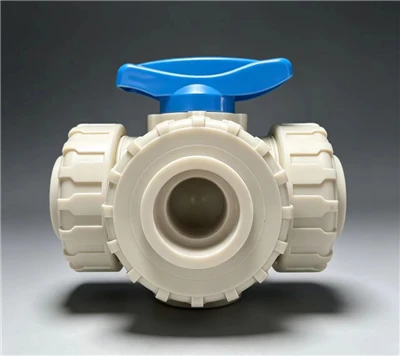


Product Range
PVC True Union Ball Valve
Body Material: UPVC (Unplasticized Polyvinyl Chloride)
Size Range: 1/2" - 4" (DN15 - DN100)
Seat / O-Ring: PTFE / EPDM or FKM (Viton)
Pressure Rating: PN16 (1/2"-2"), PN10 (2-1/2"-4") @ 23 deg C
End Connections: ANSI Socket, DIN Socket, NPT Threaded, BSPT Threaded
Primary Media: Water treatment, cold acids, alkaline solutions, municipal water, brine.
CPVC True Union Ball Valve
Body Material: CPVC (Chlorinated Polyvinyl Chloride)
Size Range: 1/2" - 4" (DN15 - DN100)
Seat / O-Ring: PTFE / FKM (Viton)
Pressure Rating: PN16 (1/2"-2"), PN10 (2-1/2"-4") @ 23 deg C; max temp up to 93 deg C (200 deg F)
End Connections: Schedule 80 Socket, NPT Threaded, Flanged
Primary Media: Hot corrosive liquids, industrial plating solutions, hot acids, bleach lines.
PPH True Union Ball Valve
Body Material: Polypropylene Homopolymer (PPH)
Size Range: 1/2" - 3" (DN15 - DN80)
Seat / O-Ring: PTFE / FKM or EPDM
Pressure Rating: PN10 (145 PSI) @ 20 deg C
End Connections: Fusion Socket (DIN/ISO), Butt Fusion, Threaded
Primary Media: Pickling lines, chemical distribution, sulfur-containing liquids, high-alkali applications.
PVDF True Union Ball Valve
Body Material: Polyvinylidene Fluoride (PVDF)
Size Range: 1/2" - 2" (DN15 - DN50)
Seat / O-Ring: PTFE / FKM or FFKM
Pressure Rating: PN16 (232 PSI) @ 20 deg C; operating up to 120 deg C (248 deg F)
End Connections: Socket Fusion, Butt Fusion, ANSI Flanged
Primary Media: Concentrated acids (nitric, sulfuric), ultra-pure water (UPW), semiconductor chemicals, halogen compounds.
Plastic Flanged Ball Valve
Body Material: PVC, CPVC, PPH, PVDF
Size Range: 1-1/2" - 4" (DN40 - DN100)
Flange Drilling: ANSI Class 150, DIN PN10/16, JIS 10K
Face-to-Face Standard: ISO 5752 / EN 558 series 1
Primary Media: Industrial piping mains, pump skid connections, large chemical transfer lines.
Plastic Threaded Ball Valve
Body Material: PVC / CPVC
Size Range: 1/2" - 2" (DN15 - DN50)
Thread Type: NPT (ANSI B1.20.1), BSPT (ISO 7-1)
Design Type: Single Union / Compact / Double Union
Primary Media: Irrigation systems, OEM water purification skids, chemical dosing lines.

Full-Port Bore: Inner diameter matches pipe size, reducing turbulence and keeping pressure drop across the valve to a minimum.
Double Block & Bleed / True Union Structure: Carrier nuts on both sides allow inline maintenance without disturbing adjacent piping. The carrier remains locked under full pipeline pressure.
Blow-out Proof Stem: Internal stem installation prevents the stem from ejecting under overpressure conditions.
Encapsulated PTFE Seats: Pure PTFE seats with backing elastomeric cushions maintain tight sealing across frequent thermal cycling.
ISO 5211 Mounting Pad Options: Direct-mount capability for pneumatic and electric actuators without external brackets.
Material & Media Compatibility
|
Material |
Max Temp (deg C / deg F) |
Compatible Media |
Unsuitable Media |
Continuous Working Pressure (23 deg C) |
|
PVC |
60 deg C / 140 deg F |
Dilute acids, bases, salts, water, aliphatic hydrocarbons |
Aromatic hydrocarbons, esters, ketones, hot fluids |
150 PSI (10 bar) |
|
CPVC |
93 deg C / 200 deg F |
Hot mineral acids, sodium hypochlorite, aggressive chemicals |
Ketones, ethers, chlorinated hydrocarbons |
150 PSI (10 bar) |
|
PPH |
90 deg C / 194 deg F |
Caustics, pickling acids, organic solvents, salts |
Strong oxidizing agents (fuming HNO3), halogens |
145 PSI (10 bar) |
|
PVDF |
120 deg C / 248 deg F |
Concentrated H2SO4, HNO3, HCl, ozone, high-purity media |
Fuming sulfuric acid, strong polar solvents (DMAc, DMF) |
232 PSI (16 bar) |
O-Ring Material Selection:
EPDM: Water, caustics, dilute acids, alcohols, ozone. Not for oils/hydrocarbons.
FKM (Viton): Strong inorganic acids, chlorinated solvents, aromatic hydrocarbons, oils. Not for hot water/steam or ammonia.
Connection & Configuration Options
Connection Types
Solvent Cement Socket:
Standards: ASTM D2467 (Schedule 80), DIN 8063, ISO 727.
Typical Uses: Rigid PVC/CPVC permanent piping assemblies.
Threaded (NPT / BSPT):
Standards: ANSI B1.20.1 (NPT), ISO 7-1 (BSPT).
Note: Use PTFE tape or non-solvent thread sealants designed for plastics.
Flanged:
Standards: ANSI B16.5 Class 150, EN 1092-1 PN10/16.
Note: Flange torque must follow plastic-specific limits (typically 15-25 Nm) using flat rubber gaskets.
Heat Fusion / Welding:
Standards: DVS 2207 (PPH/PVDF Socket/Butt Fusion).
Typical Uses: Industrial chemical lines requiring zero-leakage welded joints.
Actuation & Control
Manual: Ergonomic ABS/PP handle with integrated lockout feature.
Pneumatic Actuated: Double-acting or Spring-Return (NC/NO) with NAMUR solenoid interface and limit switch box.
Electric Actuated: 24V DC / 110V AC / 220V AC, IP67 enclosure, 4-20mA modulating or ON/OFF control, manual override.

How to Select the Right Plastic Ball Valve
Follow this step-by-step selection process to match operating conditions with the right valve configuration:
Identify the Fluid Medium and Working Temperature
Acid/Alkaline below 60 deg C -> PVC
Hot acids/Chlorinated fluids up to 90 deg C -> CPVC
Caustic solutions/Industrial solvents up to 90 deg C -> PPH
Concentrated oxidizing acids/Ultra-pure media up to 120 deg C -> PVDF
Calculate Working Pressure and Thermal Derating
Plastic pressure ratings drop as temperature rises. Verify that the operating pressure falls within the material's derating curve (e.g., PVC rating drops from 150 PSI at 23 deg C to 42 PSI at 50 deg C).
Select End Connection Standard
Match pipeline specs: US Schedule 80 (ASTM) vs. European Metric (DIN/ISO).
Select Elastomeric Seals (O-Rings)
Use EPDM for water, caustics, and mild chemicals.
Use FKM for acids, oils, and organic compounds.
Determine Operation Type
Manual hand-lever for infrequent isolation.
ISO 5211 direct-mount interface for automated systems (Pneumatic/Electric).
Applications
Industrial Water & Wastewater Treatment
Chemical dosing (sodium hypochlorite, ferric chloride), acid neutralization, reverse osmosis (RO) skid piping.
01
Chemical Processing
Transfer lines for sulfuric, hydrochloric, and nitric acids; chlor-alkali production facilities.
02
Semiconductor & Electronics
Ultra-pure water (UPW) distribution using high-purity PVDF double-contained piping.
03
Metal Finishing & Electroplating
Hot acid pickling lines, tank isolation, rinse bath fluid management.
04
Aquaculture & Commercial Marine
Saltwater recirculation loops, filtration racks, ozone treatment systems.
05
Quality & Inspection
All valve assemblies undergo multi-stage quality control steps before shipment:
Raw Material Verification: MFI (Melt Flow Index) testing and density checks on incoming resin batches (100% virgin resin, zero recycled scrap content).
Dimensional Inspection: CMM and digital caliper verification of body thread pitches, wall thickness tolerances (ASTM/DIN), and socket entry dimensions.
100% Shell & Seat Pressure Test: Every manufactured valve undergoes hydrostatic shell testing at 1.5x PN rating and pneumatic seat leakage testing at 6 bar (ISO 5208 Class A zero leakage).
Torque & Cycle Testing: Random sample batch testing for opening/closing torque consistency across 5,000 cycles under simulated working pressure.
Traceability: Heat number laser-marked on bodies and recorded on 3.1 Material Test Reports (MTR) upon request.
We provide custom engineering for global distributors, valve integrators, and equipment manufacturers (OEMs):
Custom Labeling & Branding
Laser engraving of customer logos, custom valve handle colors, custom brand packaging, and private label barcode tags.
Material Modifications
Custom-compounded resins (UV-inhibited PVC, flame-retardant PP, antistatic additives).
Actuation Assemblies
Factory assembly and testing of customer-specified pneumatic/electric actuators, limit switches, and positioners.
Specialized End Connections
Mixed end connections (e.g., Male Thread x Socket Union), metric-to-imperial transition unions.
Tooling & Mold Development
In-house mold design and tooling manufacturing for custom valve dimensions or specialized flow channels.
FAQ
We're well-known as one of the leading plastic ball valves manufacturers in China. If you're going to buy high quality plastic ball valves in stock, welcome to get quotation and free sample from our factory. Also, customized service is available.