PPH True Union Ball Valve
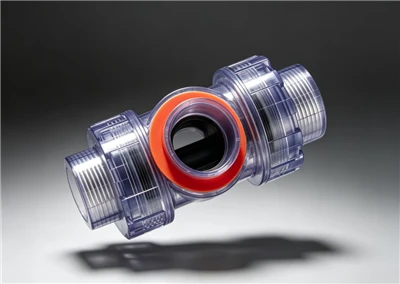
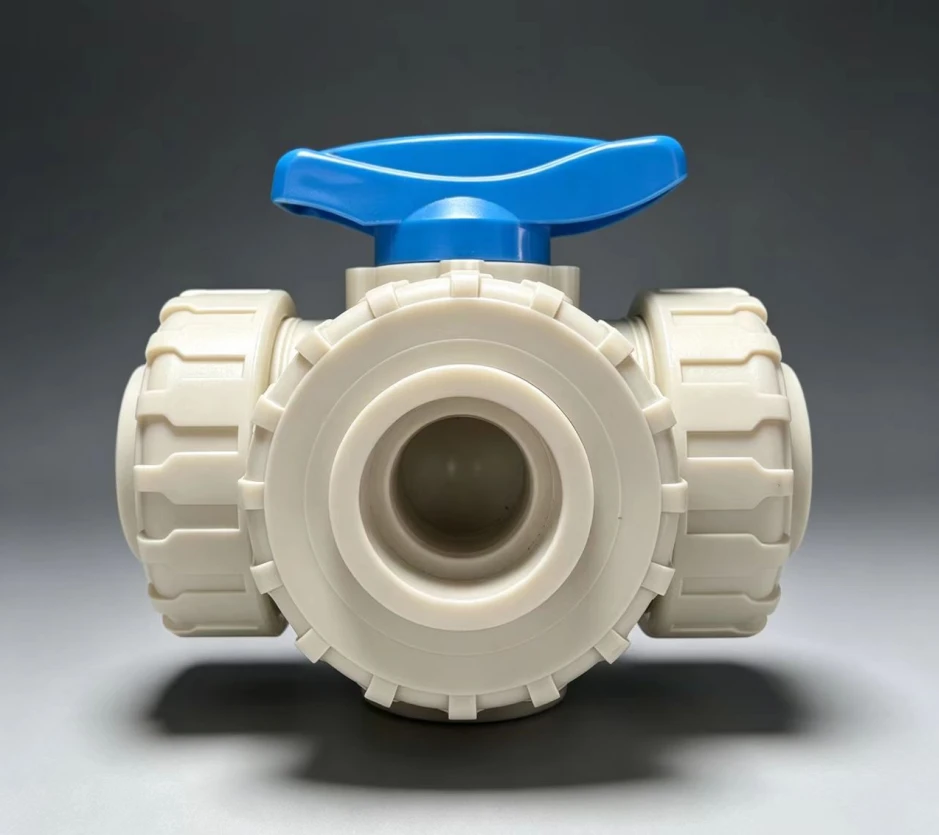
This PPH (Polypropylene Homopolymer) true union ball valve provides bidirectional flow isolation in corrosive fluid handling systems. The double true union design allows complete valve body removal from the pipeline without cutting pipe or disturbing end connections, minimizing downtime during seat and seal replacements.
Description
Product Overview
This PPH (Polypropylene Homopolymer) true union ball valve provides bidirectional flow isolation in corrosive fluid handling systems. The double true union design allows complete valve body removal from the pipeline without cutting pipe or disturbing end connections, minimizing downtime during seat and seal replacements. Standard pressure rating reaches PN10/PN16 (145/232 PSI) at 20 degrees C, operating within a temperature range of 0 degrees C to 95 degrees C (32 degrees F to 203 degrees F).
Key Product Characteristics
Inline Serviceability: Double union nuts permit total dismantling of the central body for inline maintenance while maintaining upstream pressure.
Corrosion Resistance: Pure homopolymer PP construction resists strong alkalis, inorganic salts, and non-oxidizing acids up to 95 degrees C.
Low Torque Operation: Machined micro-smooth ball surface and self-lubricating PTFE seats maintain smooth torque profiles across high-cycle operations.
Blowout-Proof Stem: Internal stem assembly prevents stem ejection under elevated line pressure.
Actuation Ready: ISO 5211 direct-mount pad option enables direct mounting of electric or pneumatic actuators without external mounting brackets.
Key Specifications
|
Parameter |
Specification |
|
Size Range |
DN15 - DN100 (1/2" - 4") |
|
Pressure Rating |
PN10 / PN16 (145 PSI / 232 PSI) at 20 degrees C |
|
Temperature Range |
0 degrees C to 95 degrees C (32 degrees F to 203 degrees F) |
|
Body Material |
Beta-PPH (Polypropylene Homopolymer) |
|
Ball / Stem Material |
PPH |
|
Seat Material |
PTFE (Teflon) |
|
O-Ring Seals |
EPDM or FKM (Viton) |
|
End Connections |
Socket Weld (DIN/ANSI/JIS), Threaded (NPT/BSPT), Flanged (ANSI 150lb/PN10) |
|
Operation |
Manual Lever, ISO 5211 Direct-Mount for Electric/Pneumatic Actuation |
Materials & Media Compatibility
PPH Body & Ball: Beta-fine crystalline structure offers higher impact strength and thermal resistance than standard PP-R or block PP. Excellent resistance to sodium hydroxide, hydrochloric acid (up to 30%), sulfuric acid (up to 70%), and industrial wastewater.
PTFE Seats: Chemical resistance against nearly all industrial solvents and reagents, ensuring zero seat leakage.
EPDM O-Rings: Suitable for water treatment, alkaline solutions, dilute acids, and alcohols. Not suitable for petroleum solvents or concentrated hydrocarbons.
FKM (Viton) O-Rings: Selected for strong mineral acids, petroleum products, chlorinated hydrocarbons, and higher thermal stress environments.
Connection & Configuration Options
Socket End Connections
Fusion-welded sockets conforming to DIN 8077/8078, ASTM D2846, or JIS standards to ensure monolithic joint integrity.
Threaded Connections
Precision CNC-cut NPT (ANSI B1.20.1) or BSPT threads for rigid mechanical piping systems.
Flanged Ends
Integral or two-piece stub end flanged adapters matching ANSI Class 150 or DIN PN10 bolt patterns.
Actuation Prep
Standardized ISO 5211 mounting flange pattern allows conversion from manual handle to pneumatic or electric actuator within minutes.
Application-Specific Design Considerations
Thermal Expansion: PPH has a linear expansion coefficient of approximately 1.5 x 10^-4 / K. Pipeline designs must account for thermal expansion, especially above 60 degrees C, using expansion loops or flexible joints to prevent axial piping stress on union threads.
Pressure-Temperature De-rating: Maximum working pressure decreases as operating temperature increases. At 60 degrees C, working pressure de-rates to 60% of PN rating; at 95 degrees C, working pressure de-rates to 20%.
Oxidizing Media Limits: PPH is not recommended for nitric acid above 40%, wet chlorine gas, or concentrated sulfuric acid above 90%.
Applications
Industrial Water & Wastewater Treatment
Dosing lines, acid/alkali neutralization tanks, and DI water distribution lines.
Chemical Processing
Handling ambient and elevated-temperature inorganic acids, caustic soda, and saline solutions.
Surface Finishing & Electroplating
Acid pickling recirculation, plating tank filtration, and waste line control.
Chlor-Alkali Facilities
Brine purification and sodium hypochlorite transfer piping.
Quality & Inspection
Every valve undergoes rigorous factory testing before shipment:
Hydrostatic Shell Test: Tested at 1.5x nominal pressure (PN24 for PN16 valves) to verify structural body integrity.
Seat Leak Test: Pneumatic air-under-water pressure test at 6 bar according to ISO 5208 / EN 12266-1 Rate A (zero visible leakage).
Dimensional Verification: CNC thread gauge inspection and socket inner diameter check against ISO 727 / DIN 8077 tolerances.
Torque Testing: Operating torque validated across open-close cycles to prevent dry-stem binding.
OEM / ODM & Customization
We provide tailored valve manufacturing services for OEMs, distributors, and EPC contractors:
Custom Branding: Laser etching or molded customer logo on body, handle, or stem cap.
Custom O-Ring & Seat Compounds: Special high-purity or low-temperature elastomer compounds upon request.
Actuator Integration: Pre-assembly and calibration of electric or pneumatic actuators, limit switch boxes, and positioners prior to dispatch.
Custom Packaging: Individual barcoded boxes, neutral packaging, or private-label bulk crates.
FAQ
Q: What is the main structural advantage of a True Union design over a Single Union or Monolithic Ball Valve?
A: the central valve body to be isolated and slid out laterally from the pipeline without cutting the pipe or unthreading adjacent line segments. This enables inline replacement of internal seals in minutes.
Q: How do I select between EPDM and FKM seal options for my application?
A: Select EPDM for general water treatment, caustic soda (NaOH), dilute acids, and applications requiring flexibility down to 0 degrees C. Select FKM (Viton) for higher chemical concentration, continuous temperatures above 60 degrees C, mineral acids, and lines containing trace oils or hydrocarbons.
Q: Can this PPH valve be directly automated with an electric or pneumatic actuator?
A: Yes. Valves ordered with an ISO 5211 mounting pad can directly mate with standard electric or pneumatic actuators without custom mounting kits. The valve stem features a standard double-D or square drive for direct coupling.
Q: How does temperature affect the maximum allowable operating pressure of this valve?
A: Maximum pressure ratings (e.g., PN16 / 232 PSI) apply at 20 degrees C. As operating temperature rises toward the 95 degrees C limit, the allowable pressure decreases according to standard thermoplastic de-rating curves (approx. 10 bar at 40 degrees C, 6 bar at 60 degrees C, 2 bar at 95 degrees C).
Q: What fusion welding parameters are recommended for PPH socket connections?
A: Socket fusion should be performed using standard PPH heating tools set to 260 degrees C +/- 10 degrees C (500 degrees F - 518 degrees F). Heating and insertion times depend on pipe diameter (e.g., 5-7 seconds heat time for DN25/1" pipe). The valve body must be in the fully open position during heating and joining to prevent thermal distortion of the ball seat.
Q: What quality test certificates are available with bulk shipments?
A: Standard shipments include EN 10204 3.1 Material Test Certificates, Hydrostatic & Pneumatic Test Reports, and Dimensional Inspection Sheets. Raw material batch certificates for Beta-PPH resin can also be provided upon request.
Hot Tags: pph true union ball valve, China pph true union ball valve manufacturers, factory
Send Inquiry
You Might Also Like