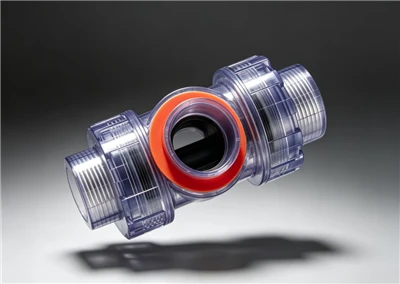
CPVC True Union Ball Valve
CPVC true union ball valves enable bi-directional flow control and section isolation in aggressive chemical and high-temperature liquid systems. The double true union design permits in-line maintenance, seat adjustment, and carrier replacement without cutting the pipeline or removing flanged connections.
Description
Product Overview
CPVC true union ball valves enable bi-directional flow control and section isolation in aggressive chemical and high-temperature liquid systems. The double true union design permits in-line maintenance, seat adjustment, and carrier replacement without cutting the pipeline or removing flanged connections.
Suitable for operating temperatures up to 93 deg C (200 deg F), these valves handle acids, bases, salts, and sodium hypochlorite where standard PVC degrades.
Key Product Characteristics
Full-Port Flow Path: Matches nominal pipe inner diameter to minimize pressure drop and fluid turbulence.
Double Block and Bleed Capability: Dual union nuts allow downstream pipe disassembly under pressure while the valve remains closed upstream.
Adjustable Threaded Seal Carrier: Enables manual pre-tightening of PTFE seats to restore internal tightness after extended thermal cycling.
Blowout-Proof Stem Design: Internal stem insertion prevents stem ejection under elevated line pressure.
Integrated Actuator Mounting Pad: ISO 5211 compliant top flange allows direct conversion to pneumatic or electric actuation without external brackets.
Key Specifications
|
Parameter |
Value / Range |
|
Nominal Size Range |
DN15 to DN100 (1/2 in. to 4 in.) |
|
Pressure Rating at 23 deg C (73 deg F) |
PN16 / 232 PSI (1/2 in. to 2 in.); PN10 / 150 PSI (2-1/2 in. to 4 in.) |
|
Working Temperature Range |
0 deg C to 93 deg C (32 deg F to 200 deg F) |
|
Body Material |
Chlorinated Polyvinyl Chloride (CPVC, Cell Class 23447) |
|
Seat Material |
PTFE (Teflon) with elastomer backing cushions |
|
O-Ring Seal Options |
EPDM or FKM (Viton) |
|
Port Type |
Full Bore |
|
Applicable Standards |
ASTM F1970, DIN 8063, ISO 16135 |
Materials & Media Compatibility
Body Material: CPVC
Extruded or molded from cell class 23447 CPVC resin. Offers higher mechanical strength and higher heat distortion temperature than standard PVC.
O-Ring Selection Matrix
EPDM: Recommended for water treatment, sodium hydroxide, dilute acids, alcohols, and alkaline solutions. Unsuitable for petroleum products, oils, and concentrated hydrocarbon solvents.
FKM (Viton): Recommended for concentrated mineral acids (hydrochloric, nitric, sulfuric up to 70%), sodium hypochlorite, fuel, and organic solvents. Unsuitable for hot water, steam, or low-molecular-weight organic acids.
Connection & Configuration Options
End Connections
Socket Ends: ANSI / ASTM D2846 (Schedule 80), DIN / ISO 15493, JIS K6776 solvent cement sockets.
Threaded Ends: NPT (ANSI B1.20.1) or BSPT (ISO 7-1) female threads.
Flanged Ends: ANSI Class 150 or DIN PN10/16 bolt patterns via true union stub ends and backing rings.
Actuation Options
Ergonomic manual handle with built-in spanner tool for union nut adjustment.
Pneumatic double-acting or spring-return actuators.
Electric actuators (24V DC, 110V AC, 220V AC) with manual override and position indicator.
Application-Specific Design Considerations
Thermal Expansion & Pressure Derating: Operating pressure decreases as temperature rises. At 80 deg C (176 deg F), the working pressure must be derated to 40% of the nominal rating at 23 deg C.
Sodium Hypochlorite Outgassing: For bleach service, gas trapping inside the ball cavity can cause overpressurization. Specify vented ball configurations (1mm relief hole on the upstream side).
Solvent Cement Installation: Ensure CPVC-specific heavy-bodied solvent cement and primer (ASTM F493 compliant) are used. Prevent cement pooling inside the valve cavity during assembly to protect PTFE seats.
Applications
Industrial Acid & Alkali Lines
Distribution of sulfuric acid, hydrochloric acid, and caustic soda in chemical processing plants.
Metal Finishing & Electroplating
Corrosive pickling and plating chemical circulation loops operating at 60 deg C to 85 deg C.
Water & Wastewater Treatment
Dosing systems for ferric chloride, sodium hypochlorite, and fluorosilicic acid.
Semiconductor Wet Benches
Deionized water and chemical reagent feed lines requiring non-metallic fluid contact.
Quality & Inspection
Every production batch undergoes the following factory test protocol prior to packing:
Dimensional & Thread Gauge Verification: Socket depths checked per ASTM D2846; threads checked with go/no-go plug gauges.
Shell Hydrostatic Test: Shell tested at 1.5x PN rating for 60 seconds with water at 20 deg C (zero structural leakage).
Seat Tightness Test: Pneumatic seat leak test at 0.6 MPa (6 bar) air pressure for 30 seconds (zero bubble leakage).
Torque Testing: Operating torque measured to ensure smooth manual actuation within 3 N.m to 12 N.m depending on size.
OEM / ODM & Customization
We provide custom valve manufacturing based on client drawings and technical specifications:
Private Labeling & Branding: Laser-etched or molded logos on handles, union nuts, and valve bodies.
Material Customization: Custom compound formulations, color matching (Gray, Light Gray, Orange), and specialized seal materials (FFKM).
Packaging & Kitting: Barcoded individual boxes, customized multi-lingual instruction sheets, and pre-assembled valve-actuator packages.
Traceability: Heat-number batch tracking marked on valve bodies for quality audit requirements.
FAQ
Q: What is the maximum pressure rating for CPVC true union ball valves at elevated temperatures?
A: At 23 deg C (73 deg F), 1/2 in. to 2 in. valves are rated at 16 bar (232 PSI). At 80 deg C (176 deg F), the maximum working pressure drops to 6.4 bar (92 PSI), and at 93 deg C (200 deg F), it drops to 3.2 bar (46 PSI).
Q: How do I select between EPDM and FKM O-rings for my fluid medium?
A: Choose EPDM for general water treatment, sodium hydroxide, and mild acids. Select FKM for concentrated acids, bleach (sodium hypochlorite), oils, and aromatic hydrocarbons.
Q: Can the valve be repaired without removing it from the pipeline?
A: Yes. Unthreading both union nuts isolates the valve body. The center body slides out laterally, allowing seat, ball, and stem seal replacement while socket or threaded ends remain connected to the pipe.
Q: Can these valves handle vacuum service?
A: Yes. The threaded seal carrier holds the PTFE seats tightly against the ball under vacuum conditions down to 730 mmHg (0.03 bar absolute).
Q: Are replacement parts interchangeable across different standards?
A: Union nuts, end connectors, and bodies are standard-specific (ANSI, DIN, JIS). End connectors must match the pipe standard, though internal components (ball, seats, stem) remain consistent within the same body platform.
Q: Do you supply material test reports (MTR) and certificate of compliance with shipments?
A: Yes. EN 10204 3.1 material certificates, hydrostatic test reports, raw material compliance certificates (RoHS, REACH), and 2D/3D CAD files (STEP/IGES format) are available upon request.
Hot Tags: cpvc true union ball valve, China cpvc true union ball valve manufacturers, factory
Send Inquiry
You Might Also Like