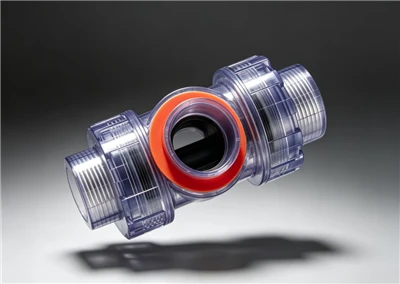
Plastic Flanged Ball Valve
The Plastic Flanged Ball Valve provides reliable flow isolation and directional control in highly corrosive and chemical-handling piping systems where metallic valves fail or require frequent maintenance. Engineered with direct-molded flanged connections, this valve eliminates stress concentration points associated with threaded adapters.
Description
Product Overview
The Plastic Flanged Ball Valve provides reliable flow isolation and directional control in highly corrosive and chemical-handling piping systems where metallic valves fail or require frequent maintenance. Engineered with direct-molded flanged connections, this valve eliminates stress concentration points associated with threaded adapters. The full-port design maintains maximum flow capacity with minimal pressure drop across line sizes from 1/2" to 4" (DN15 to DN100).
Key Product Characteristics
Monolithic Body Construction: One-piece molded body structure reduces leak paths compared to multi-piece metal-to-plastic assemblies.
Integrated Flange Ends: Bolt pattern integrated directly into the valve mold prevents thread shear under dynamic piping loads.
Bi-Directional Sealing: Dual o-ring stem seals and micro-finished ball geometry ensure bubble-tight shutoff regardless of flow direction.
Low Torque Operation: Machined PTFE seats reduce friction during manual or automated actuation cycles.
Actuation Ready: Features top-mounting pads for direct coupling with ISO 5211 pneumatic and electric actuators without requiring secondary bracket machining.
Key Specifications
|
Parameter |
Specification / Standard |
|
Nominal Diameters |
1/2" - 4" / DN15 - DN100 |
|
Pressure Rating |
PN10 (145 PSI) / PN16 (232 PSI) @ 20 degrees C (68 degrees F) |
|
Temperature Limits |
UPVC: 0 degrees C to 60 degrees C (32 degrees F to 140 degrees F) CPVC: 0 degrees C to 95 degrees C (32 degrees F to 203 degrees F) PPH: -10 degrees C to 90 degrees C (14 degrees F to 194 degrees F) PVDF: -40 degrees C to 120 degrees C (-40 degrees F to 248 degrees F) |
|
Flange Standards |
ANSI B16.5 Class 150 / DIN EN 1092-1 PN10/16 / JIS 10K |
|
Seat Material |
PTFE (Teflon) |
|
O-Ring Seal Options |
EPDM / FKM (Viton) / FFKM |
|
Operation Type |
Lockable Manual Lever, ISO 5211 Pneumatic, ISO 5211 Electric |
Materials & Media Compatibility
UPVC (Unplasticized Polyvinyl Chloride): Resistant to acids, alkalis, salts, and oxidized media. Suited for water treatment, municipal chemical feeds, and general acidic fluid transport.
CPVC (Chlorinated Polyvinyl Chloride): Enhanced thermal stability up to 95 degrees C. Suitable for hot corrosive fluids, industrial plating, and concentrated chemical handling.
PPH (Polypropylene Homopolymer): Resistance to strong alkalis, organic solvents, and high-purity water systems. Low moisture absorption prevents fluid contamination.
PVDF (Polyvinylidene Fluoride): Inert material designed for high-purity media, aggressive acids (hydrochloric, nitric, sulfuric), and high-temperature corrosive environments.
Connection & Configuration Options
ANSI Class 150 Flange: Standard bolt circle dimensions for seamless integration with US schedule piping systems.
DIN PN10/PN16 Flange: Standard metric bolt drilling for European process skid integration.
JIS 10K Flange: Compatible with Asian regional industrial piping standards.
Flat Face (FF) Surface: Prevents flange cracking caused by uneven torque applied during installation against flat-faced mating flanges.
Application-Specific Design Considerations
Thermal Expansion: Thermoplastics expand at higher rates than metals. Flange bolts must be torqued in a star pattern to precise values to avoid over-compression of gaskets.
Water Hammer Prevention: Manual quarter-turn levers include optional gearbox operators for sizes above 3" (DN80) to slow down closure speed and protect plastic piping systems from pressure surges.
UV Protection: UV-inhibiting additives incorporated into the resin compound prevent polymer degradation and embrittlement in exposed outdoor installations.
Applications
Chemical Processing
Dosing systems, acid transfer lines, caustic soda production, and inline fluid mixing.
Water & Wastewater Treatment
Desalination plants, municipal chlorination systems, wastewater neutralization, and reverse osmosis skids.
Industrial Surface Finishing
Electroplating line chemical circulation, pickling baths, and metal etching fluid management.
Aquaculture & Marine
Seawater intake systems, filtration loops, and corrosive salt brine transport.
Quality & Inspection
Each valve undergoes factory inspection protocols prior to packing:
Hydrostatic Pressure Test: Shell tested at 1.5x working pressure rating to verify structural integrity.
Pneumatic Seat Leakage Test: Air pressure tested at 0.6 MPa on both upstream and downstream ports to verify zero-leakage shutoff.
Dimensional Verification: Flange thickness, bolt-hole circle diameters, and face-to-face dimensions checked against ISO / ANSI standards via coordinate measuring equipment.
Torque Testing: Operating torque measured before shipment to ensure consistency for automated actuator mounting.
OEM / ODM & Customization
Custom Flange Drilling
Non-standard bolt circle pattern modifications available upon request.
Private Labeling
Laser-etched or molded brand logos, custom handle colors, and tailored tag numbers.
Actuation Assemblies
Factory-assembled and pre-calibrated pneumatic or electric actuator packages with limit switches and positioners.
Custom Materials
Specialty elastomer o-ring supply (FFKM) for aggressive organic solvent applications.
FAQ
Q: How do I select between EPDM and FKM (Viton) o-ring seals for my valve?
A: Choose EPDM for water, steam, dilute acids, and alkaline solutions. Select FKM (Viton) for concentrated acids, petroleum products, oils, and chlorinated solvents.
Q: Can plastic flanged ball valves be direct-coupled with metal pipe flanges?
A: Yes. Use Flat Face (FF) metal flanges with full-face soft gaskets (EPDM or PTFE). Torquing must strictly follow specified plastic flange torque limits to prevent cracking the plastic flange face.
Q: What torque sequence should be used when installing flanged plastic valves?
A: Use a calibrated torque wrench. Tighten bolts incrementally in a crisscross (star) pattern to 20%, 50%, and finally 100% of the recommended torque rating to ensure uniform gasket compression.
Q: Can this valve be automated after field installation?
A: Yes. Remove the manual handle to access the ISO 5211 mounting pad. Actuators can be bolted directly using standard drive shafts without custom mounting kits.
Q: What causes valve stem leakage, and can seals be replaced in the field?
A: Stem leaks typically result from chemical attack on elastomer seals or thermal cycling. Stem o-rings and PTFE ball seats can be serviced by removing the valve from line and disassembling the body thread retainer.
Q: What is the maximum operating pressure at elevated temperatures?
A: Thermoplastic pressure capacity decreases as temperature rises. For example, a UPVC valve rated at 10 BAR (145 PSI) at 20 degrees C dereates to approximately 2.5 BAR at 60 degrees C. Review the temperature-pressure de-rating chart before finalizing specifications.
Hot Tags: plastic flanged ball valve, China plastic flanged ball valve manufacturers, factory
Send Inquiry
You Might Also Like