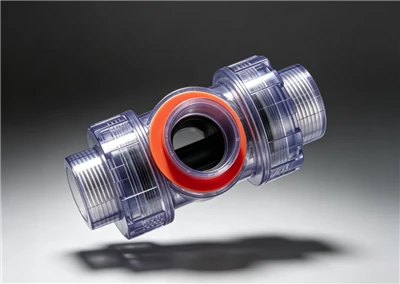
PVDF Check Valve
This Polyvinylidene Fluoride (PVDF) check valve prevents backflow and prevents cross-contamination in aggressive chemical, ultra-pure water, and elevated-temperature fluid handling systems.
Description
Product Overview
This Polyvinylidene Fluoride (PVDF) check valve prevents backflow and prevents cross-contamination in aggressive chemical, ultra-pure water, and elevated-temperature fluid handling systems. Engineered as a true union spring-loaded / ball-check structure, it operates in both vertical and horizontal pipelines. The solid molded PVDF body resists strong acids, halogens, and organic solvents without metal contact or fluid contamination.
Key Product Characteristics
Zero Metal Contact: Internal fluid path contains no metallic parts, eliminating ion leaching in ultra-pure applications.
Corrosion Resistance: Retains mechanical integrity under concentrated nitric acid, hydrofluoric acid, wet chlorine, and organic solvents.
Low Cracking Pressure: Standard cracking pressure starts at 0.015 MPa (2.17 PSI), minimizing system head loss.
Dual-Union Maintenance: Allows inline body removal without disassembling connected piping networks.
Smooth Internal Finish: Injection-molded internal surfaces feature Ra < 0.8 μm surface roughness to prevent bacterial accumulation and mineral scaling.
Key Specifications
|
Parameter |
Specification / Value |
|
Nominal Diameters |
DN15 to DN50 (1/2" to 2") |
|
Body Material |
100% Virgin PVDF (Polyvinylidene Fluoride) |
|
Seal Options |
FKM (Viton) / EPDM / PTFE-coated FKM |
|
Pressure Rating (at 20°C) |
PN10 / 150 PSI |
|
Operating Temperature Range |
-20°C to +120°C (-4°F to +248°F) |
|
Cracking Pressure |
0.015 MPa to 0.03 MPa (2.17 PSI to 4.35 PSI) |
|
Connection Standards |
ANSI B16.5 Class 150 / DIN / JIS / Socket Fusion |
|
CAD Models Available |
2D (.DWG) / 3D (.STEP) models available upon request |
Materials & Media Compatibility
PVDF Body: Compatible with strong mineral acids (HCl, H2SO4 up to 98%, HNO3), halogen compounds, aliphatic/aromatic hydrocarbons, and ozone. Unsuitable for strong alkaline solutions (e.g., concentrated NaOH > 30% at high temperatures) and polar solvents like acetone or DMF.
FKM Seals: Recommended for concentrated acids, oils, petroleum products, and strong oxidizers up to 120°C.
EPDM Seals: Recommended for hot water, diluted acids, alkalis, and alcohols. Not compatible with hydrocarbons.
PTFE Seals: Universal chemical resistance across full temperature range; optimized for high-purity microelectronics process lines.
Connection & Configuration Options
Socket End (ANSI / DIN / JIS)
Heat socket fusion for homogeneous, leak-free plastic joins.
Threaded End (NPT / BSPT)
Direct mechanical integration into threaded rigid piping circuits.
Flanged End (ANSI 150 lb / DIN PN10)
For high-vibration sections or integration with steel/lined pipe systems.
True Union vs. Single Union
Double union design enables symmetrical disassembly, reducing system maintenance downtime.
Application-Specific Design Considerations
Pressure De-rating Matrix: Max operating pressure decreases linearly as media temperature increases:
- 20°C: 10.0 bar (145 PSI)
- 60°C: 7.2 bar (104 PSI)
- 90°C: 4.8 bar (70 PSI)
- 120°C: 2.5 bar (36 PSI)
Installation Orientation: Spring-assisted check valves operate in vertical (upward flow only) and horizontal orientations. Gravity-assisted ball check valves require vertical upward flow configurations.
Backpressure Requirements: Requires a minimum reverse pressure of 0.05 MPa (7.25 PSI) to guarantee drip-tight sealing across low-viscosity liquids.
Applications
Semiconductor & Photovoltaic Manufacturing: Ultra-pure water (UPW) distribution loops and wet-bench chemical etching lines.
Chemical Processing: Chlor-alkali transport, acid pickling lines, and reagent dosing systems.
PCB Manufacturing: Copper etching solution recirculating loops and plating lines.
Industrial Wastewater Treatment: Dosing lines handling concentrated sodium hypochlorite, ferric chloride, and industrial waste acids.
Quality & Inspection
Each production batch undergoes standard factory testing before dispatch:
Hydrostatic Shell Test: Tested at 1.5x nominal pressure (1.5 MPa) for 60 seconds according to ISO 5208 / EN 12266-1.
Seat Tightness Test: Reverse pneumatic testing at low pressure (0.05 MPa) and high pressure (1.0 MPa) to ensure zero bubble leakage.
Dimensional Inspection: Critical dimensions verified via CMM and optical profile projectors.
Material Traceability: Raw materials tested via Melt Flow Index (MFI) meters and FTIR spectroscopy. Material certificates (EN 10204 3.1) provided upon request.
OEM / ODM & Customization
Custom Cracking Pressures: Spring constants engineered from 0.005 MPa to 0.1 MPa for specific flow profiles.
Material Customization: Conductive PVDF options available for explosive / ATEX-regulated operating environments.
Private Labeling & Packaging: Laser-etched part numbers, custom logos, trace codes, cleanroom packaging (ISO Class 7 double-bagging), and direct STEP/CAD file integration for engineering validation.
FAQ
Q: How does temperature affect the working pressure of this PVDF check valve?
A: Thermoplastics lose tensile strength at elevated temperatures. While rated at 10 bar (145 PSI) at 20°C, the maximum allowable pressure drops to 2.5 bar (36 PSI) at 120°C. Always reference the pressure-temperature de-rating curve during valve selection.
Q: Can this check valve handle slurries or media with suspended solids?
A: No. Solid particles can settle on the sealing seat, causing backflow leakage or mechanical jamming. For fluids with particulates, upstream basket strainers or y-strainers must be installed.
Q: What is the difference between FKM and EPDM seals for PVDF valves?
A: FKM provides superior resistance to concentrated acids, hydrocarbons, and halogenated compounds up to 120°C. EPDM excels in hot water, steam, and alkaline media, but fails rapidly in oil, hydrocarbon, or concentrated acid service.
Q: Is this PVDF check valve suitable for vacuum service?
A: Standard socket and flanged true-union configurations handle vacuum down to 0.01 bar absolute pressure at ambient temperature. High-vacuum applications above 60°C require reinforced elastomer seal selections.
Q: Why choose PVDF over standard PVC or CPVC for chemical lines?
A: PVDF offers higher temperature limits (120°C vs 60°C for PVC, 90°C for CPVC), superior mechanical strength, broader chemical resistance (particularly against hot concentrated acids), and lower trace element extraction for high-purity media.
Q: What standard documentation accompanies an order?
A: Standard shipments include standard factory compliance certificates. Order-specific EN 10204 3.1 material test reports, pressure test logs, and raw resin compliance sheets (FDA / USP Class VI) can be requested prior to production.
Hot Tags: pvdf check valve, China pvdf check valve manufacturers, factory
Send Inquiry
You Might Also Like